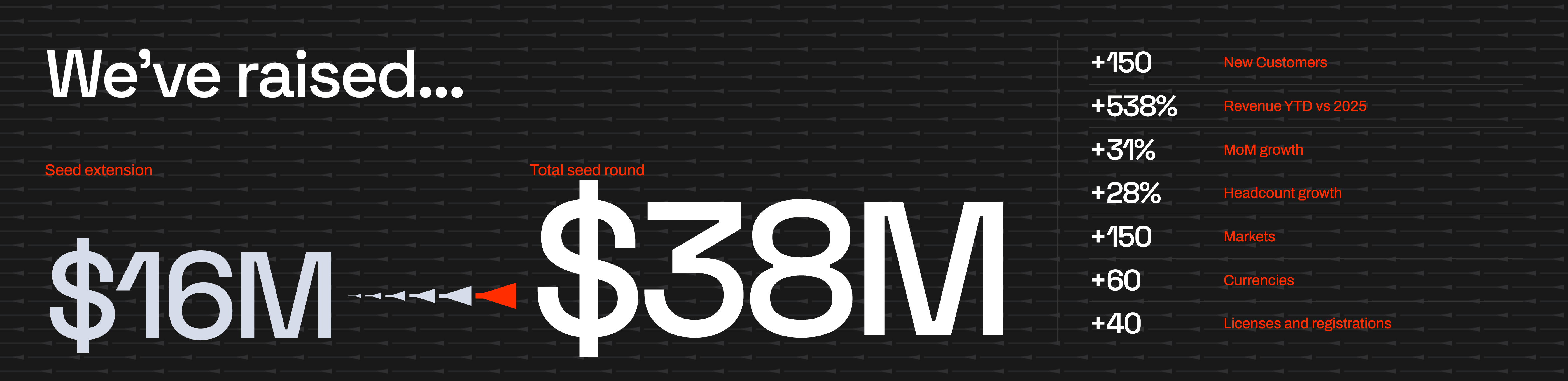
LONDON, UK – 7th October 2026 – Noah, the stablecoin payments infrastructure provider, has closed its seed funding round at $38 million following the raise of an additional $16 million from new and existing investors, a milestone that arrives at the end of the strongest twelve months in the company's history and at a moment when some of the world's largest platforms and financial institutions are beginning to move their cross-border payment flows away from correspondent banking and onto stablecoin settlement.
The extension, backed by Endeit Capital, FJ Labs, LocalGlobe, Felix Capital and a select group of high-profile angel investors, follows a period of growth that has seen Noah's year-to-date revenue for 2026 rise by 538% compared with the same period in 2025, with the business continuing to compound at 31% month on month. Over the same period, Noah has signed more than 150 new customers, spanning global platforms and financial institutions across remittances, fintech, marketplaces and payroll, each of them looking for a faster, cheaper and more transparent way to move money across borders than the chains of intermediary banks that have defined international payments for decades.
The new capital will be used to expand Noah's regulatory footprint, recruit engineering and compliance specialists, deepen its connections with local payment rails in its highest-volume markets, and accelerate its expansion into the United States through the opening of a new office in New York
The Case for New Rails
Every generation of financial infrastructure is defined by the rails it lays. SWIFT standardised international bank messaging in the 1970s, and Visa and Mastercard built the global card networks in the decades that followed; each became the invisible plumbing through which trillions of dollars moved, and each was shaped by the technology and assumptions of its time. Correspondent banking, which still underpins most cross-border transfers today, is a product of that same era, designed around overnight batch processing and a world in which money could only move as quickly as banks could reconcile their ledgers with one another.
"Stablecoins combine the digital flexibility of digital currencies with the stability of fiat to allow money to move at the speed of the internet. We are able to replace the slow and expensive traditional banking approach to international transfers with a single settlement platform," said Shah Ramezani, Co-Founder and CEO of Noah.
The cost of that design is now measured in hundreds of billions of dollars. Cross-border payments reached $208 trillion in 2025, generating an estimated $625 billion in annual revenue for banks and intermediaries, and that burden is far from evenly shared. Small and medium-sized businesses account for just 7% of total cross-border flows, yet they generate 31% of banks' revenue from those flows, paying an estimated $191 billion a year in fees, foreign exchange spreads and operational charges simply to reach customers, suppliers and contractors in other countries. (FXC Intelligence)
Stablecoins offer a fundamentally different model, combining the speed and programmability of digital assets with the price stability of fiat currency, and businesses are adopting them at pace. B2B stablecoin payments have reached an annualised value of $226 billion, an increase of 733% year on year. Even so, stablecoins still account for less than 1% of the $34.8 trillion in annual cross-border B2B payments, which suggests that the shift now under way is not the end of a cycle but the very beginning of one. (McKinsey)
Stablecoins Explained
It is estimated that around $60 billion was lost to remittance fees in 2025, much of it absorbed by the chain of intermediaries a payment passes through on its way across a border. A typical transfer still travels from a sending bank through one or more correspondent banks to a receiving bank, with each one taking a fee, a cut on foreign exchange and a share of the time; sending $200 across borders costs an average of 6.36%, according to the World Bank, and settlement can take anywhere from one to five days, with nothing moving at all on weekends or bank holidays.
A stablecoin is a digital token worth exactly one dollar, or one euro, backed 1:1 by cash and short-term government debt held by a regulated issuer. Because it moves on public blockchains in much the same way that email moves across the internet, a stablecoin payment is always on, settles in seconds at any hour of any day, and costs cents rather than percentages.
What was once a niche instrument has become a substantial market. Around $300 billion in stablecoins is now in circulation, $33 trillion moved on-chain in 2025, up 72% on the previous year, and Citi projects the market could reach between $1.9 trillion and $4 trillion by 2030. Regulation is maturing alongside it: the US GENIUS Act was signed in July 2025 and the EU's MiCA framework came fully into force in July 2026, giving companies such as Stripe, Mastercard and Visa the clarity to build on these rails.
Businesses, however, do not live on-chain. Their customers, suppliers and teams are paid through local systems such as PIX in Brazil, SPEI in Mexico, M-Pesa in Kenya, Faster Payments in the UK and UPI in India, and it is this last mile that Noah connects, collecting funds, converting between fiat and stablecoins with compliance built in, and paying out on the local rails that people actually use.
Noah: The Settlement Layer for How Money Moves Now
Noah was founded to close that gap by building the infrastructure that sits between stablecoin settlement and the local payment rails that businesses and individuals rely on every day. Rather than routing a payment through a sequence of correspondent banks, each adding its own delay, fee and point of failure, Noah settles value on stablecoin rails and connects it directly to local payment systems at both ends of the transaction, so that funds can move across borders in seconds rather than days.
"Noah is building the infrastructure that will make one-click international transactions possible everywhere, with full compliance at both the origination and destination of funds. Just as neobanks have revolutionised domestic banking, we want to redefine global money transfer markets," added Shah Ramezani.
Just as importantly, Noah builds compliance into the network itself rather than treating it as a layer to be added afterwards. International money movement is among the most heavily regulated activities in financial services, and every country, currency and payment method brings its own requirements for licensing, local partnerships, integrations and controls. By bringing on-ramps, off-ramps and compliance together in a single network, with compliance applied at both the origination and destination of funds, Noah allows its customers to reach new markets without having to rebuild that infrastructure themselves, one jurisdiction at a time.
Co-Founder Thijn Lamers, who spent a decade as part of the founding team at global payments company Adyen, said: "Stablecoin is critical to the future of money movement. International transfers are highly regulated and increasingly challenging as every country, currency, and payment method requires local partnerships, integrations, and compliance infrastructure. We founded Noah to set money free by building an international network where the on-ramps, off-ramps and compliance are built in, so that payments can move seamlessly across the world."
Today the network is live in more than 150 markets and supports more than 60 currencies. Noah serves enterprises and individuals directly, and it reaches a far broader base of end users through partnerships with consumer platforms, fintech companies, neobanks and workforce platforms, each of which aggregates large numbers of businesses, contractors and individuals who depend on reliable international payments.
Scaling to Meet Demand
The defining challenge for Noah over the past year has not been finding demand but keeping pace with it. As enterprise customers have moved larger and more complex payment flows onto the network, the company's constraint has shifted away from its commercial pipeline and towards the people, licences and operational capacity required to serve that pipeline well.
"Over the next 12 months, Noah is scaling its business to the level required to support four to five times its current revenue, with our longer term ambition to become the underlying network through which businesses move money internationally. We want to make stablecoin settlement invisible to the companies and individuals benefiting from it," said Thijn Lamers, Co-Founder of Noah.
That momentum has put Noah in a position to invest ahead of demand, building out the team, licences and infrastructure needed to serve its customers at scale.The new funding is directed squarely at that constraint, across four priorities:
• Regulatory Footprint: expanding Noah's licensing and regulatory coverage so that it can serve more customers, in more markets, with the same standard of compliance at every stage of a payment.
• Engineering and Compliance Talent: recruiting the specialists needed to scale both the platform and the controls around it as transaction volumes continue to grow.
• Local Payment Rails: deepening Noah's connections with local payment systems in its highest-volume markets, improving speed, coverage and cost in the corridors its customers use most.
• US Expansion: opening a new office in New York to accelerate Noah's expansion in the United States.
Over the next twelve months, Noah plans to scale the business to a level capable of supporting four to five times its current revenue, laying the foundations for a longer-term ambition to become the underlying network through which businesses move money internationally.
Backed by Investors Who Know Payments
The round brings together investors with deep experience in financial technology and payments infrastructure, including Endeit Capital, FJ Labs, LocalGlobe and Felix Capital, alongside a select group of high-profile angels.
"Cross-border payments still run on rails built decades ago, and we had been looking for the leader in stablecoin infrastructure for some time. We found it in Noah: the team and product are setting the standard in the space, and the customer traction shows the demand is real. Backing Thijn and Shah was a no-brainer, and we can't wait to see them take Noah to the next level," said Jonne de Leeuw, Partner at Endeit Capital.
Founded in 2006, Endeit Capital invests its €300M+ fund in Europe's most promising growth-stage technology companies, with a focus on energy tech, fintech, the future of work and security.

Setting Money Free
Noah's mission has been consistent since the company was founded: to set money free, so that a payment to a supplier, contractor or family member in another country is as simple, fast and affordable as a payment down the street. The progress of the past year, from the growth in revenue and customers to the confidence shown by new and existing investors, signals that the market is ready for that shift, and that the infrastructure enabling it will matter as much to the next era of global commerce as the card networks and messaging systems did to the last.
With fresh capital, a growing regulatory footprint and a new presence in New York, Noah is now focused on making stablecoin settlement invisible to the businesses and individuals who benefit from it, so that money simply moves, wherever it needs to go.
As featured in Axios, PYMNTS, Tech.eu, Finextra, FF News and more. Noah is hiring engineering and compliance specialists, including for its new New York office. Learn more/ apply.
