Introduction
Global payment expansion runs ahead of the compliance and risk infrastructure meant to support it. Every new corridor a fintech opens multiplies its exposure: more jurisdictions, more regulatory regimes, and more ways for money to move and be misused. Growth that looks linear on a revenue chart shows up as compliance exposure that compounds with every market you add.
Most teams pour their budget into day-one onboarding and treat verification as the hard part. Once a user clears KYC, visibility drops to near zero. The account is approved, the dashboard goes green, and transaction-level risk runs unwatched.
Exploitation exists within this gap; identity context sits in one system, payment behavior in another, and the two rarely speak. A fraud network does not need to beat your onboarding flow if it can operate freely the moment it is inside.
This report looks at where payment risk shows up after approval, why point-in-time identity checks miss it, and what an integrated trust and movement layer looks like in practice.
The fragmented fintech stack problem
Most fintech risk stacks come together one tool at a time. One vendor for KYC, another for AML screening, a separate payment router, a fraud tool bolted on later (often after an incident, which is its own tell). Each works on its own, yet none shares a data layer.
The cost shows up everywhere: duplicated user checks that push good customers toward the exit, high drop-off at onboarding, and risk signals scattered across four dashboards that never correlate.
A few patterns we see again and again:
- A user clears KYC cleanly, then starts firing off suspicious micro-transactions hours later, and nothing connects the two events
- The payments team flags abnormal treasury velocity, but has no line of sight into that user's identity risk profile
- Compliance officers stall in manual review because the signals they need live in four different systems
Stitching independent tools together produces one thing: an expensive, fragmented stack full of blind spots, the kind sophisticated fraud syndicates are built to find.
Why KYC alone is not enough
KYC is a snapshot. It captures who a user is at the moment they sign up and freezes that judgment in place. Risk does not hold still, as it is behavioral, fluid, and it shifts the second money starts moving.
A bad actor can present clean, legitimate, sometimes stolen credentials, pass every onboarding check, and then turn to multi-accounting or digital smurfing once inside. The identity that cleared verification tells you nothing about what that identity does at transaction three hundred.
KYC answers "who is this user?"
Transaction monitoring answers "what is this user doing right now?"
Treating verification as the finish line leaves the entire post-approval lifecycle uncovered. Continuous monitoring closes that window, watching behavior, velocity, and device signals against live watchlists for as long as the account stays active.
Where payment risk appears after onboarding
Onboarding is the front gate. The danger zones sit further down the funnel, at every point where value moves: deposits, intra-platform transfers, withdrawals, cross-border settlement corridors, and stablecoin off-ramping.
Moving money internationally adds its own complications as well. Settlement windows differ by region, currencies swing in value mid-transfer, and local compliance mandates shift without much notice. A payout that is routine in one corridor triggers a reporting obligation in the next.
Then there is the balancing act every payments team knows. Pile on compliance friction and checkout conversion collapses. Strip the guardrails out, and the network invites fraud at scale. The job is to hold both—conversion speed and control—as a single objective.
The unified infrastructure model
Identity systems, fraud rules, and payment engines have to communicate natively, inside one lifecycle loop, so a signal raised at the transaction layer is read against the identity that produced it. Therefore, the fix is at the architecture level.
That is the operating model Sumsub and Noah run together.
- Noah handles the movement layer: borderless payment infrastructure, stablecoin-powered settlement, automated global payouts, and a single orchestration engine.
- Sumsub handles the trust layer: identity and business verification, automated AML screening, fraud prevention, live AML transaction monitoring, applicant risk scoring, and ongoing re-authentication.
While Noah routes, converts, and executes payouts across its networks, Sumsub's embedded engine assesses user behavior, device telemetry, and global watchlists in real time. One loop, one data layer, from sign-up to settlement.
Use case: Web3 wallet and crypto exchange off-ramping
Context: A fast-scaling digital asset wallet or neobank pushing cross-border services into volatile emerging markets across LATAM and Africa.
Compliance challenge
Static identity tools drive heavy user abandonment, while risk teams struggle to enforce multi-jurisdictional AML mandates and crypto Travel Rule requirements once trading goes live.
UX and operational challenge
A patchwork of local banking partnerships props up payout corridors, driving up integration costs and forcing end users into multi-day settlement delays.
How Sumsub and Noah solve it
Sumsub deploys a unified verification layer with Reusable KYC, so pre-verified ecosystem users onboard in clicks without resubmitting documents. On validation, Noah's event-driven stablecoin API triggers an immediate local-currency payout.
Measurable impact
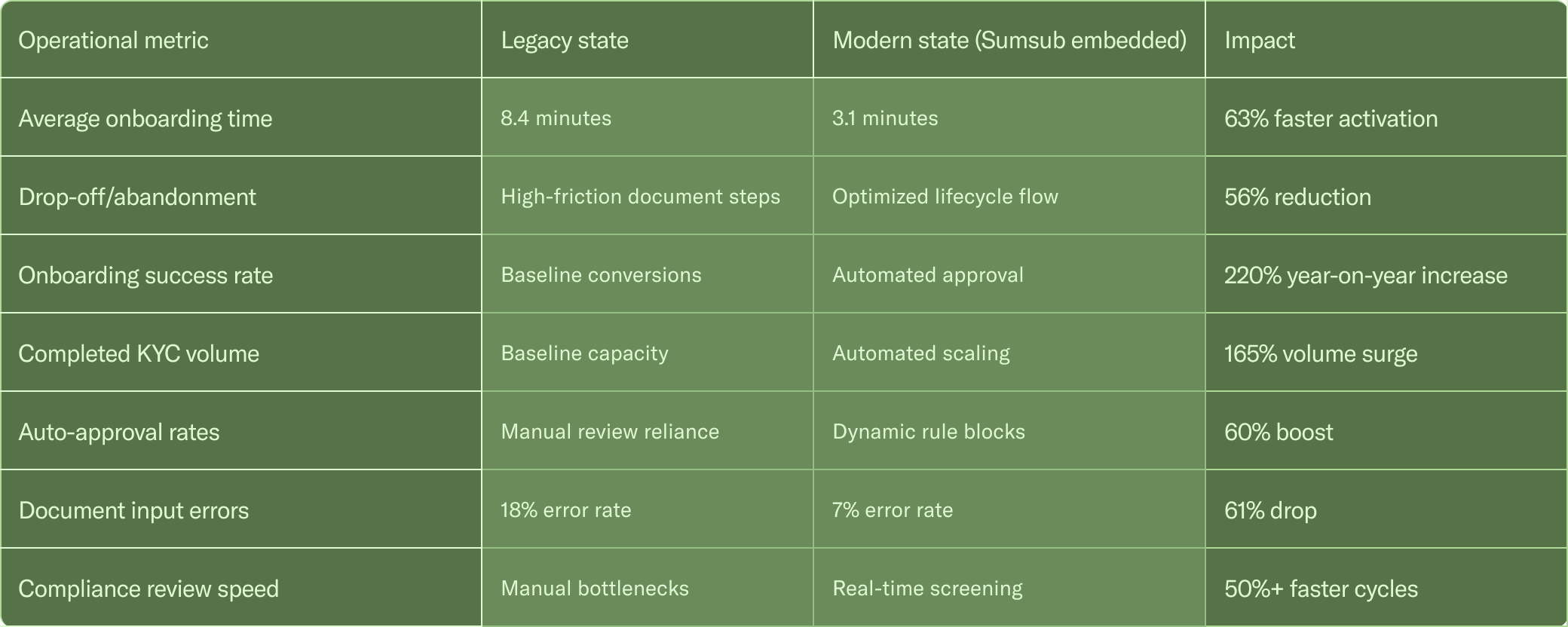
Onboarding drop-off cut by 56%, successful verifications up 220% year-on-year, and near-instant local-currency settlement to rails like PIX and M-Pesa, with no need to hold individual regional PSP licenses.
Use case: High-volume global payroll and contractor platforms
Context: An enterprise B2B payroll or Employer of Record (EOR) platform running automated monthly salary disbursements to thousands of international contractors.
Compliance challenge
Telling legitimate high-velocity payroll transfers apart from sophisticated cross-border laundering schemes and corporate fraud networks, at scale, every single cycle.
UX and operational challenge
Reliance on SWIFT and correspondent banking ties up working capital in pre-funded accounts, delays wage access by three to five days, and drains between 3% and 7% of contractor earnings in hidden intermediary fees.
How Sumsub and Noah solve it
Noah embeds the platform's treasury rules into its programmatic Orchestration layer, triggering payouts automatically as conditions are met. This enables compliant 1st-party and 3rd-party payouts globally, removing the multi-year barrier of securing localized regional PSP licensing for the platform. Sumsub operates over the top, running continuous real-time AML transaction monitoring and screening every transfer against live politically exposed person (PEP) and sanctions lists.
Outcome
Contractors receive same-day or instant local-currency settlement, and the enterprise keeps a complete, automated audit trail for regulators in every country it pays into.
How the unified flow works
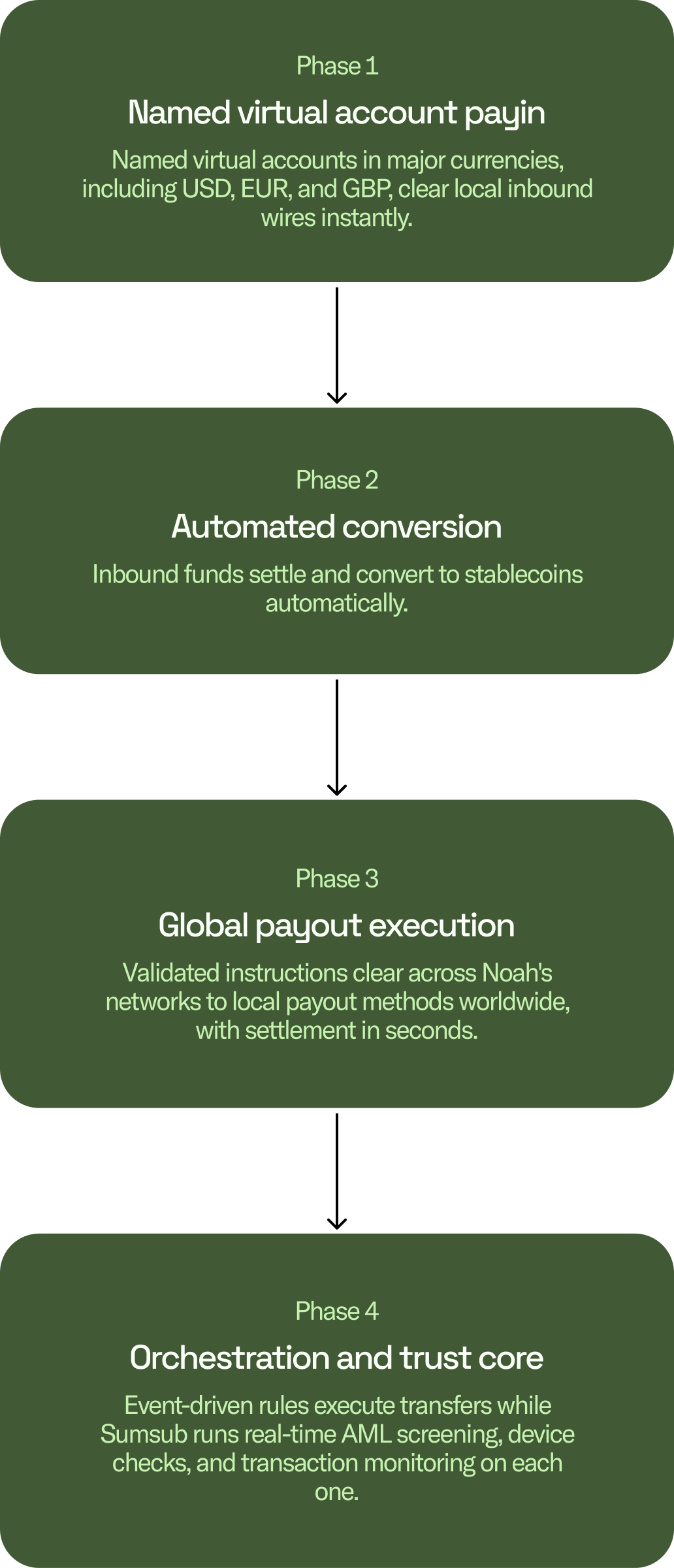
The joint stack runs as one sequence, payin to payout, with the trust layer active the whole way through:
The compliance challenge
The numbers: Noah global scale
Global payout reach
Localized payouts across 72 regional markets covering 50+ currencies, routing dynamically through local bank transfers, mobile money (like M-Pesa), and digital wallets.
Payin coverage
Named virtual accounts in major currencies (USD, EUR, GBP) clearing local domestic rails and SWIFT, instantly converting fiat to stablecoins
Settlement performance
Real-time settlement across 99% of supported corridors
Implementation agility
Developers get up and running in days rather than weeks
Core reliability
99% settlement success rate, backed by 99.9% core infrastructure uptime, with active PCI-DSS and AICPA SOC certifications.
Most of the friction teams accept that the cost of compliance is really the cost of fragmentation. Close the seams between identity and movement, and these numbers improve together.
The vision of the future
Risk moved from the point of entry to the point of transaction. Organized networks use pristine or stolen identities to clear traditional point-in-time KYC without much trouble.
The real threat is behavioral, surfacing after approval through stablecoin routing structures and transaction velocity spikes.
Leaders consistently underestimate the compliance overhead of compliant outbound payments. Paying global third-party beneficiaries means managing regional PSP licensing, capital and currency controls, and hyper-local anti-structuring rules. Run that across separate tools, and the blind spots are guaranteed.
"KYC is treated by most fintechs as the finish line. It is the warm-up lap. The real risk management begins when the money starts moving. Fintechs spend millions shaving milliseconds off checkout while their disconnected identity stacks drop more users from the funnel than any payment failure ever does." Noah Team
"What these results show is not just a faster onboarding flow, but a new standard for how compliance should work at scale. Sumsub helped us transform a major operational bottleneck into one of Noah's core competitive advantages." Shah Ramezani, CEO and Founder, Noah
"As our volume grew, we needed a verification engine that could keep pace with real-time money movement. Sumsub matched the exact velocity we required while raising our compliance and fraud-prevention standards across every global market." Evelina Hoque, Chief Compliance Officer, Noah
Next steps
Five moves that take a fintech from fragmented to integrated:
- Stop treating initial verification as the whole of compliance, and build continuous user risk profiles instead
- Connect identity signals directly to downstream payment behavior
- Remove fragmentation across separate KYC, AML, payment processing, and fraud tools
- Let automated rules absorb false positives and shrink the manual backlog
- Treat conversion speed and compliance control as one connected objective
Where Sumsub fits in
Sumsub is a single verification platform built around exactly this kind of integrated workflow. About 10 years in market, more than 4,000 clients, over 200 million individuals verified to date, and more than 690,000 fraud attempts prevented every month, drawing on a database of 2.3 million known fraudsters. One shared data layer covers user verification, business verification, AML transaction monitoring, fraud prevention, and Travel Rule compliance.
For a payments platform scaling across borders, the pieces that matter most:
- User Verification: ID Verification, Non-Doc Verification, Address Verification, and Source of Funds and Source of Wealth checks
- AML Transaction Monitoring: Real-time monitoring with 300+ ready-to-use risk scenarios, dynamic risk scoring, and FIU report generation in formats like goAML, STR, and SAR
- Fraud Prevention: Identity fraud, multi-accounting, account takeovers, payment fraud, and money mule detection
- AML Screening: 50,000+ global data sources screened in under a second, with up to 95% of matches resolved with AI assistance and false positives cut by 60%
- Case Management: Pre-built Blueprints for KYC cases, screening hits, and suspicious activity, with checklist enforcement and audit trails
One platform handles every compliance pillar, regulator-facing reporting is built in, and integration takes hours rather than months.
Where Noah fits in
Noah is the movement layer underneath compliant global payments. It runs borderless payment infrastructure, stablecoin-powered settlement, automated payouts, and a unified orchestration engine, so money clears across markets without a patchwork of local banking deals.
What that delivers for a scaling platform:
- Payin: Named virtual bank accounts in major currencies (USD, EUR, and GBP) that clear local bank transfers and SWIFT, converting inbound fiat to stablecoins instantly
- Payout: Programmatic conversion from stablecoins to 50+ fiat currencies, delivered through local methods worldwide, from bank transfer to mobile money, eMoney, and digital wallets
- Orchestration: Event-driven rules that detect funds landing in an account and trigger conversion, payout, and notifications automatically, with your treasury logic embedded directly
- Compliance stack: Real-time screening, monitoring, and Travel Rule handling, independently verified through active PCI-DSS and AICPA SOC certifications
Noah is backed by Felix Capital, FJ Labs, and LocalGlobe, and counts Circle, Ledger, Opera's MiniPay, Jupiter, Toptal, KAST, Slash, and Deel among its customers.